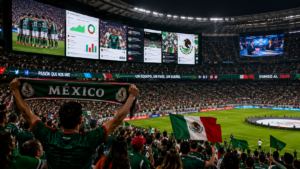
In events like the World Cup, the conversation goes far beyond football and becomes an opportunity for brands to understand the context, insert themselves with relevance, and build value through digital marketing and PR, not from mere presence, but from the ability to connect with what is truly capturing people’s attention.
There are moments when an entire country becomes a conversation. The World Cup is undoubtedly one of them. It is not just a sporting event; it is a cultural, emotional, and media platform that temporarily reshapes collective attention, and this is precisely where many brands get it wrong by treating it as just another event, when in reality it is a contextual phenomenon.
The difference between “participating” and truly capitalizing on a moment like this is not about being present, but about being relevant.
From a digital marketing perspective, the World Cup represents a unique opportunity to tap into narratives that are already emotionally charged. You do not need to build interest from scratch because it already exists; what you need is to understand how your brand can engage with that interest without appearing opportunistic or forced, which means moving away from isolated campaigns and starting to design content ecosystems that live before, during, and after the event.
The brands that stand out are those that understand that the conversation does not begin when the ball starts rolling, but much earlier, in the anticipation, in the building of expectations, in the analysis, and in the human stories behind the event, which is where content gains real value through guides, predictions, cultural insights, and collaborations with relevant voices, because the goal is not to sell, but to become part of the conversation.
On the other hand, PR plays an even more strategic role than many organizations recognize, since in events of this magnitude visibility does not depend solely on paid media, but on narrative, and the key question shifts from what we say to why anyone should listen to us now.
The brands that manage to insert themselves into the media agenda do not do so because they have the biggest budgets, but because they have something to contribute, whether through proprietary data, market insights, consumer trends, or even the cultural and economic impact of the event, turning PR into a vehicle for relevance, not just visibility.
There is also a point that is often underestimated: speed. In events like the World Cup, timing is not just important, it is everything, and while real-time marketing can be a powerful tool, without judgment it becomes noise, whereas with a clear strategy it becomes a real competitive advantage.
It is also important to understand that not all brands need to talk about football to capitalize on the World Cup, and in fact many of the most interesting executions come from brands that find alternative angles such as mobility, tourism, technology, entertainment, consumption, or even wellness, because the point is not the topic, but the connection.
Finally, the biggest lesson that an event like this leaves is that marketing and PR can no longer operate in silos, as paid amplification requires a strong narrative, and narrative requires smart distribution, and it is at that intersection where campaigns that truly resonate are built.
The World Cup will pass, like all events do, but the brands that understand how to play in these moments will not only capitalize on the opportunity, but will develop a far more valuable capability: the ability to be relevant when it actually matters.
And that, ultimately, is the hardest advantage to replicate.